
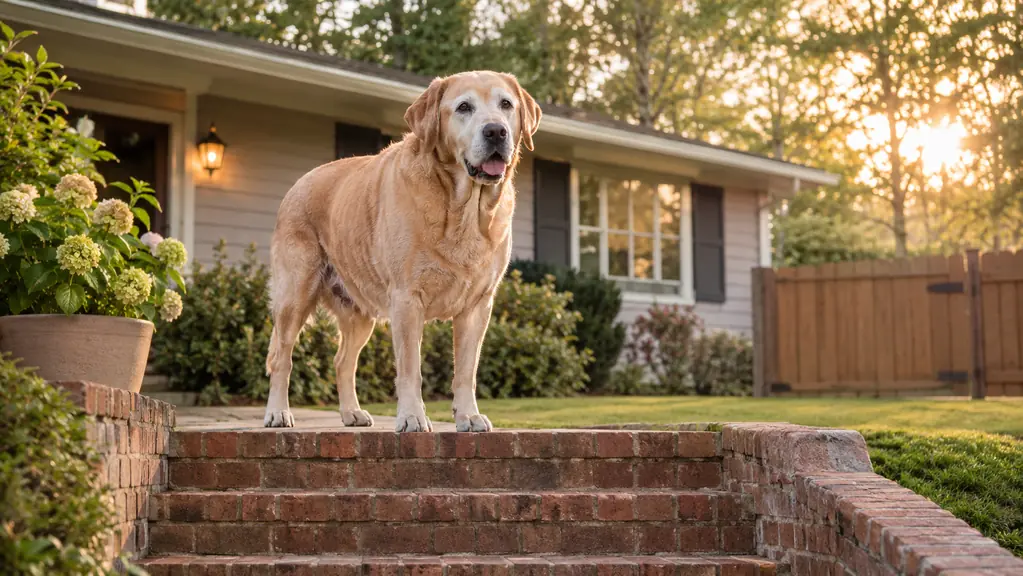
Biscuit turned ten this spring. He is a yellow Lab, about seventy-eight pounds after our vet asked me to get some weight off him. For nine years he met me at the door every time I came home. What changed was quieter than that. He started taking a beat before pushing himself up off the laminate in the hall, and he began stopping at the top of the four brick steps down to the back yard to think about it. At his September checkup our vet found mild arthritis in both hips.
The plan she gave me was the boring one: keep him lean, walk him steady, put him on a joint supplement, come back in a few months. Chews were easy at first. Biscuit treats a soft chew like dessert. Then July happened and he had a tooth pulled, and chewing anything firmer than soft food was out for the better part of two weeks. Our vet said to pause the chew and keep the joint support going with a liquid on his food instead. So I ended up in my kitchen at six in the morning with a bottle of STRELLALAB liquid glucosamine and a dog giving me the side-eye.
The workaround that got us through seven weeks of soft food
STRELLALAB Liquid Glucosamine is unflavored and mixes straight into kibble or soft food, or can be served on its own. It is the version I reached for when Biscuit could not chew a soft chew, and there is still some in my pantry.
Amazon Check Today's Price on Amazon →The Five Steps That Actually Worked
Step 1: Call Your Vet Before You Open the Bottle
The first thing I did when the tooth came out was call our vet, and the first thing she asked was what he was already taking. That question matters more than most people expect. Biscuit was on a chew and on a liquid fish oil, so the decision in front of us was whether to pause the chew for a few weeks, not whether to stack a second glucosamine product on top of it. Two joint supplements at once is not a plan. It is a guess. She okayed the swap and told me the amount to use for his weight.
When you make that call, give them the whole picture in one go: the dog's weight, what he eats, what he is already on, and how long the mouth is expected to be sore. Ours also asked me to keep him on soft food and to keep the walks short and flat while he healed, which had nothing to do with the supplement and everything to do with giving his mouth a chance to close up.
And if your dog has not been diagnosed yet, that is the appointment to make before you buy anything. Stiffness in a ten-year-old Lab is usually arthritis, but usually is carrying a lot of weight in that sentence. Our vet put her hands on both hips and watched him move across the room before she said the word. The supplement plan came after the diagnosis. It did not replace it. I am a soccer coach, not a veterinarian, and nothing here is a substitute for the one who has actually handled your dog.
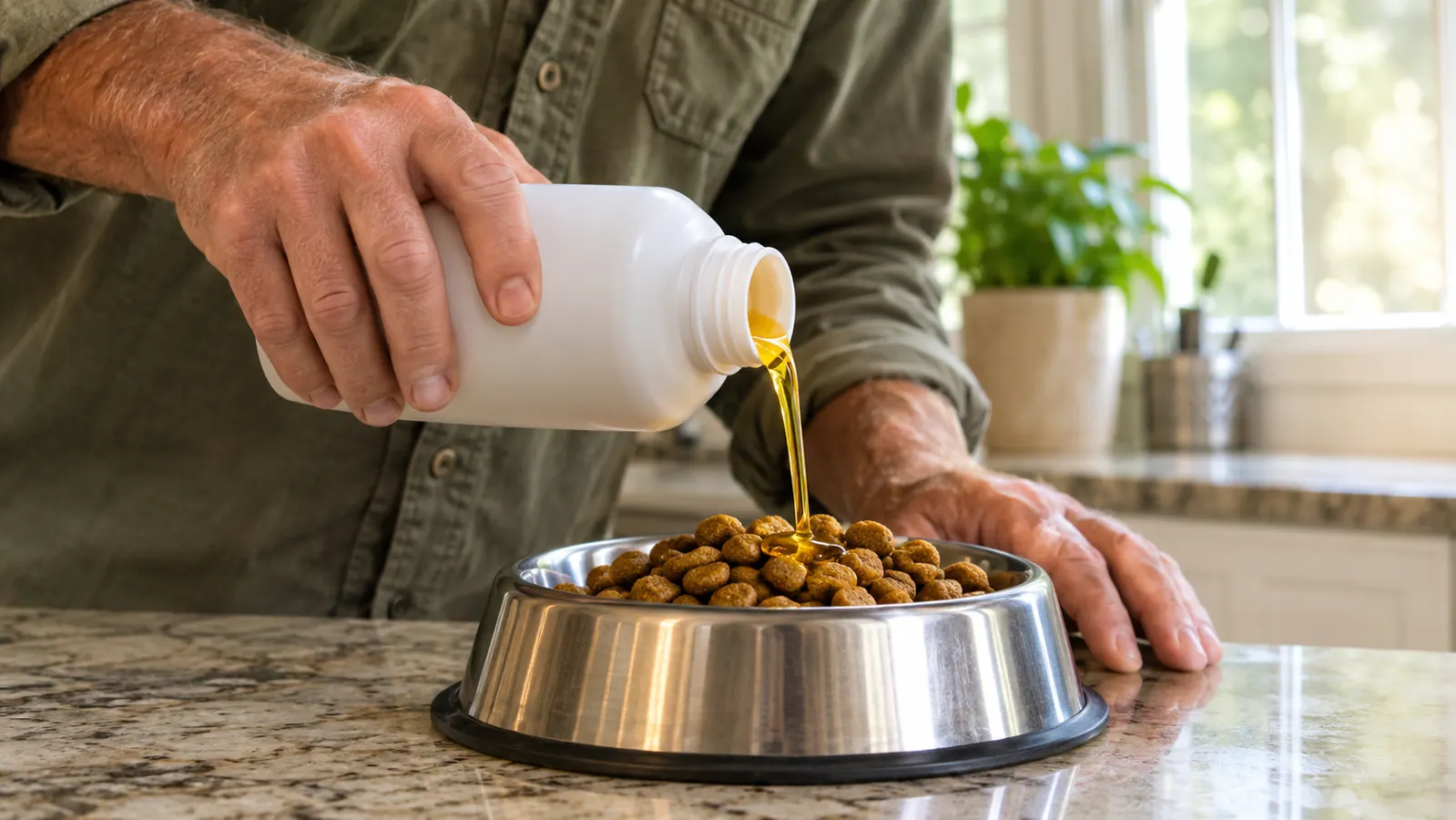
Step 2: Hang the Dose on a Meal He Already Expects
Biscuit eats twice a day, morning and evening, and the morning bowl is the busy one. That is where his fish oil goes, at the label amount for his weight, and it has been part of the routine for months. So the liquid went in right behind it.
The reason to anchor a dose to a meal is not convenience. It is memory. A dose that lives inside a routine you already perform gets given, because you were going to feed the dog anyway. A dose that lives on its own schedule gets skipped, and skipped doses are the main reason people decide a supplement did nothing when the real issue was that it went down four days out of seven. Nobody means to skip. Everybody does.
Pick the meal where your dog is hungriest and least likely to walk away from the bowl. For us that is the morning, because Biscuit sleeps through most of the afternoon and eats dinner like it is a formality he is being polite about. If your dog is the opposite, flip it. The right meal is the one you will not forget and he will not skip, and it is worth a week of watching him eat to figure out which one that is.
Step 3: Measure the Label Amount for His Weight Once, Then Stop Guessing
Liquid supplements get sloppy fast. A splash in the bowl, then a splash more because the first one looked small, and by the end of the week nobody knows what the dog is actually getting. Our vet gave me the amount for Biscuit's weight off the label and I have used that same amount every time since. One spoon, the same spoon, kept with the bottle so it does not wander off into a kitchen drawer and get replaced by something bigger.
The STRELLALAB bottle is sixteen ounces, and the label says that runs up to four months depending on the dog's weight. That tells you two things. First, you are not rebuying this every other week. Second, the measuring is the part you have to get right, because a bottle that lasts four months is a bottle where a small error repeats for four months. A kitchen scale is overkill. The same spoon every single time is not.
Weight changes the amount, which is why the number is worth rechecking. Biscuit went from eighty-four pounds down to about seventy-eight over the last year, on purpose, because our vet asked me to get him leaner. If your dog's weight moves in either direction, the label amount moves with it. Ask again at the next checkup instead of assuming last year's number still applies to this year's dog.
Four brick steps, a laminate hallway, and the back seat of a pickup. Those three spots tell me more about Biscuit's hips than anything he does in the exam room.
Step 4: Decide Up Front Whether It Goes in the Bowl or On Its Own
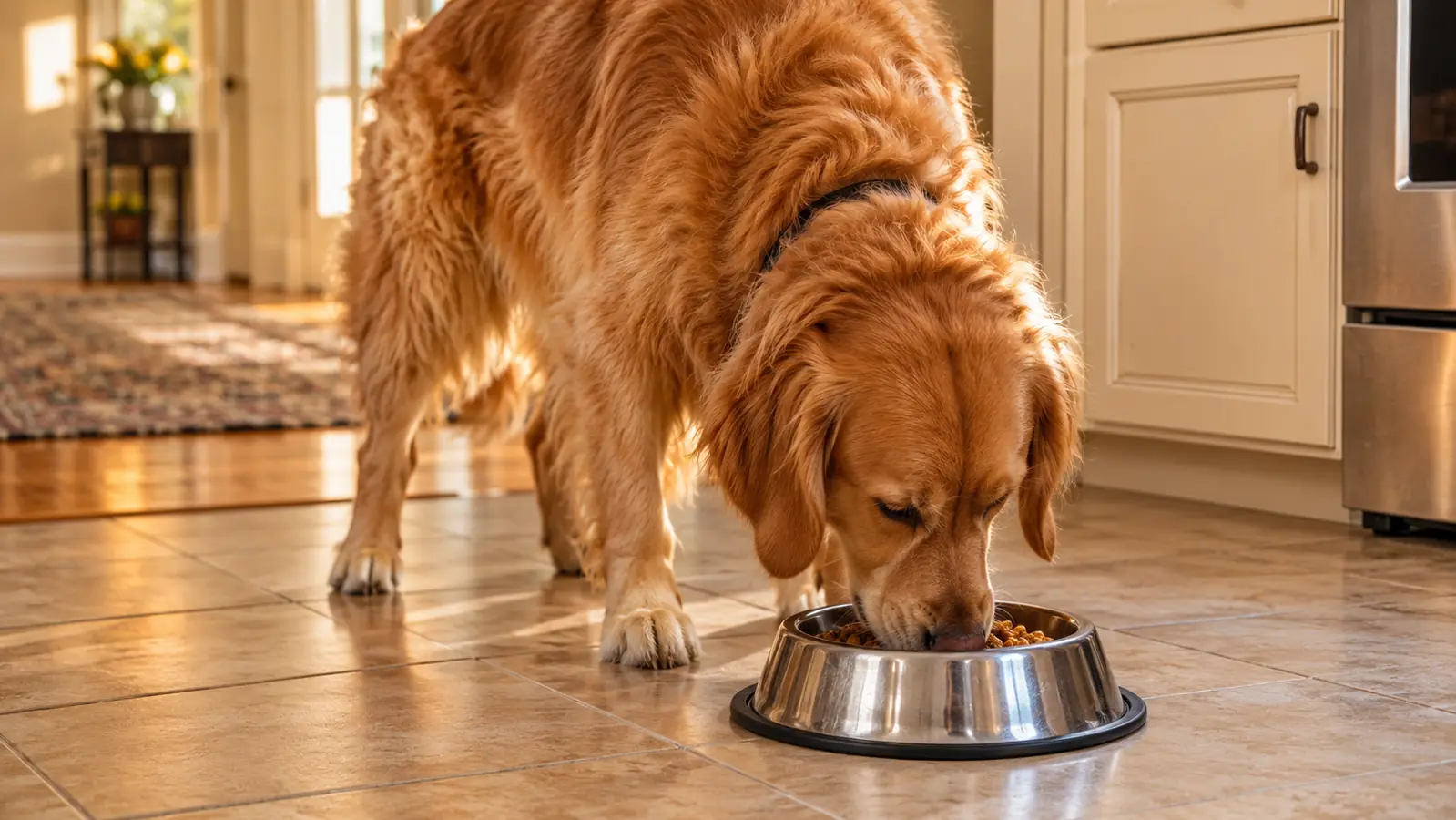
The label says it can be mixed into food or served separately, so the instructions are not going to make the decision for you. Your dog's habits will. Biscuit is a Labrador. He has never met a bowl he did not finish, so mixing it in was the entire conversation. He cleaned the bowl and looked around for more.
A pickier dog is a different job. If yours walks away from a bowl that smells unfamiliar, try it on its own first and see whether he takes it, or put it into a small portion of something he really wants and give him the rest of the meal after. If he refuses it alone, the food is still there as a fallback. Unflavored is what makes that possible, because it disappears into kibble instead of sitting on top of it and announcing itself.
One practical note from my kitchen. Do not add it and then walk away. Put it in, set the bowl down, and stay in the room for the two minutes it takes him to eat. If the dog leaves half the bowl, you want to see that now, not come back an hour later and find a puddle of soft food that tells you nothing about what he did or did not swallow.
Step 5: Give It Weeks, Not Days, and Watch Three Specific Things
This is the step where people quit too early. A joint supplement is not a pain pill and you are not going to see anything in three days. Our vet told me to give each one at least six weeks before I formed an opinion, and that has been roughly the window I have used ever since, including the seven weeks Biscuit spent on the liquid.
Give it that window and watch specific moments instead of general impressions, because general impressions are worthless. Ours were the push up off the laminate after a nap, the pause at the top of the four brick steps, and the hop into the back seat of the truck. Those are the three places an arthritic hip shows itself in my house, and those are the three I compared week to week. Write them down if you have to. Memory is generous in both directions.
During those seven weeks I did not get a dramatic change and I was not expecting one. Biscuit was on soft food, he was not doing long walks, and the honest read is that he held steady through a stretch where he could easily have gone backward. He never turned it down, which mattered more than it sounds like, because a supplement a dog refuses is a supplement that ends up in a cupboard. When his mouth healed we went back to his chew on our vet's advice, and the last of the STRELLALAB bottle is still in the pantry for the next time chewing is the problem.
What Else Helps
Weight is the biggest lever and it is not close. Our vet asked me to get Biscuit from eighty-four pounds down to about seventy-eight, which meant smaller portions and an end to the scraps off my plate. He is not a skinny dog now. He is a leaner one, and every pound off a sore hip is a pound he does not have to carry up those four steps.
Steady short walks beat heroic weekend ones. Two walks a day on flat ground around the neighborhood, plus time in the fenced yard, has done more for him than any single long outing ever did. The long hiking trips in north Georgia are the ones Biscuit sits out now. He stays with Dale down the street when I go, and he is thrilled about it, because Dale has a couch and no rules.
Flooring is a small thing that adds up. My living room and hall are laminate and my kitchen is tile, and slick floor is a real hazard for a dog with sore hips. I laid a couple of runners down in the hallway so he has something to push against instead of scrambling for grip. It took twenty minutes and I noticed the difference in how he moved through the house within a week.
Nails are worth staying on top of too. Long nails change how a dog stands, and our vet has mentioned it at more than one visit. On a dog with sore hips that is a small tax paid on every step he takes, and it is one of the few things you can fix in an afternoon.
And keep the vet in the loop about everything, including the parts that seem too small to mention. The fish oil Biscuit takes is not a glucosamine product and it runs alongside whatever chew he is on, but that is exactly the sort of detail to say out loud at an appointment so nobody is guessing about what your dog is actually swallowing. Bring the bottle with you if you are unsure. Vets read labels for a living and they are faster at it than we are.
If chewing is the problem, the liquid is the workaround
STRELLALAB Liquid Glucosamine is unflavored, mixes into kibble or soft food, and can be served on its own. A sixteen ounce bottle runs up to four months depending on your dog's weight. Ask your vet for the amount that fits your dog, then start with the meal he never misses.
Amazon Check Today's Price on Amazon →