
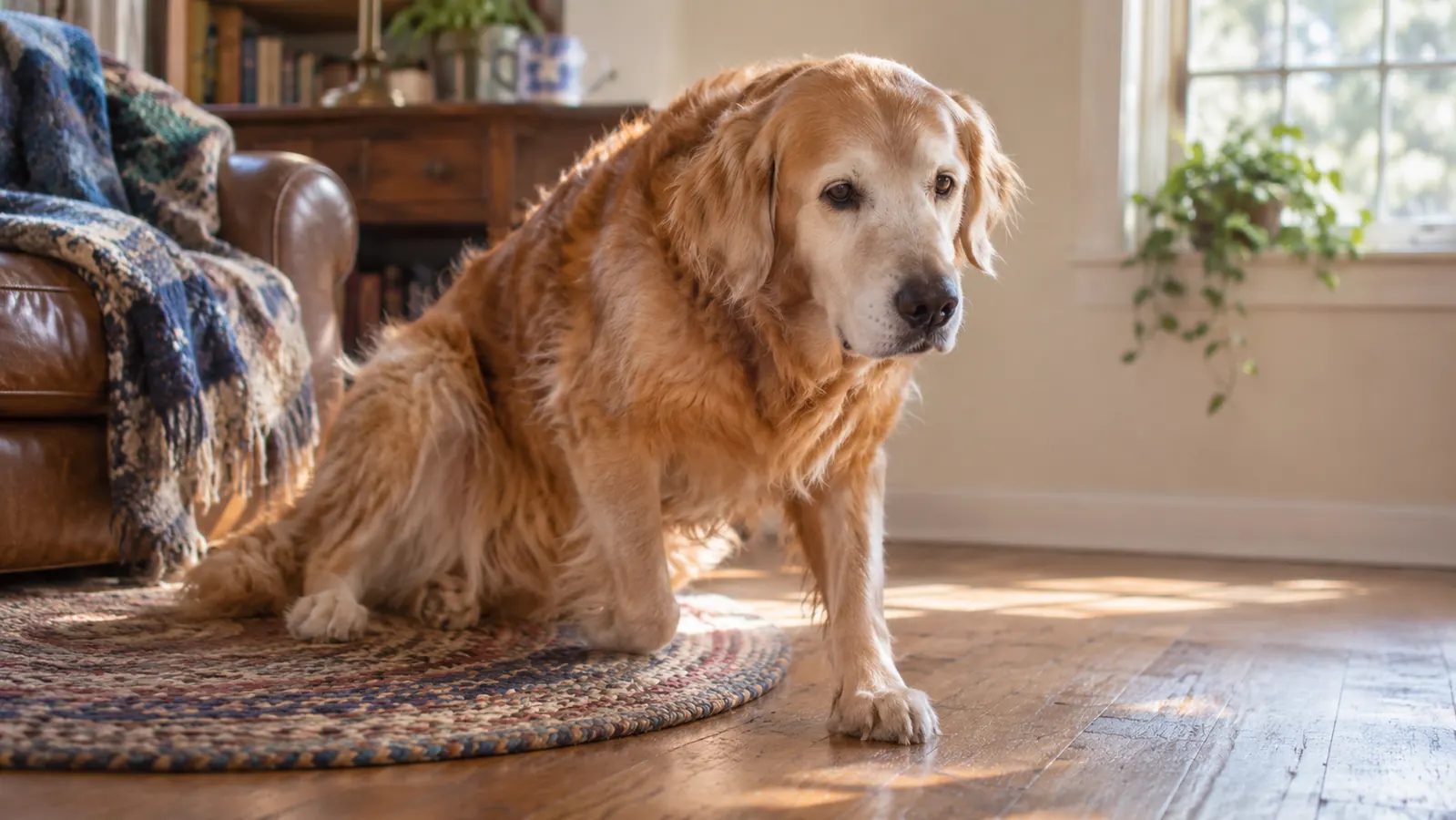
The first honest thing I can tell you about Cosequin is that it did not give me my old dog back. Biscuit is ten. Our vet found mild arthritis in both hips at his checkup in September 2025, and no chewable tablet on the market is going to reverse that. What the Cosequin chewable tablets from Nutramax Laboratories did was quieter than that, and it took me about five weeks to believe it was really happening instead of me just wanting it to.
I am Owen Pritchard. I coach high school soccer in Marietta, Georgia, and I live in a single-story ranch house with four brick steps down to the fenced back yard. Biscuit is a yellow Lab, seventy-eight pounds after our vet asked me to get him lean, and he used to come on every camping trip I took. Watching him start to hesitate before jumping into the truck is what got me reading supplement labels in the first place. That is why I am writing this instead of just leaving a star rating and moving on.
The Quick Verdict
A real but modest change, and it showed up around week five rather than week one. Worth trying if your vet has already confirmed arthritis and your dog will take a tablet like a treat.
Amazon Check Today's Price →Real change by week five, not by Wednesday
Cosequin chewable tablets are what our vet named first, and the tablet form is easy if your dog eats like mine does. Ask your vet about your dog, then read the label yourself.
Amazon Check Today's Price on Amazon →How I Ended Up on Cosequin
We started in December 2025, on our vet's suggestion. Before that I had bought a cheaper glucosamine chew myself, right after the September diagnosis, because it was the well-reviewed option on a shelf I could reach. That one was fine. Around week six his mornings looked a little easier, then it leveled off, and at the December recheck our vet said she would rather see him on a formula with more behind it. That is how Cosequin got the slot. I did not switch because the first one failed. I switched because she had a preference and I did not.
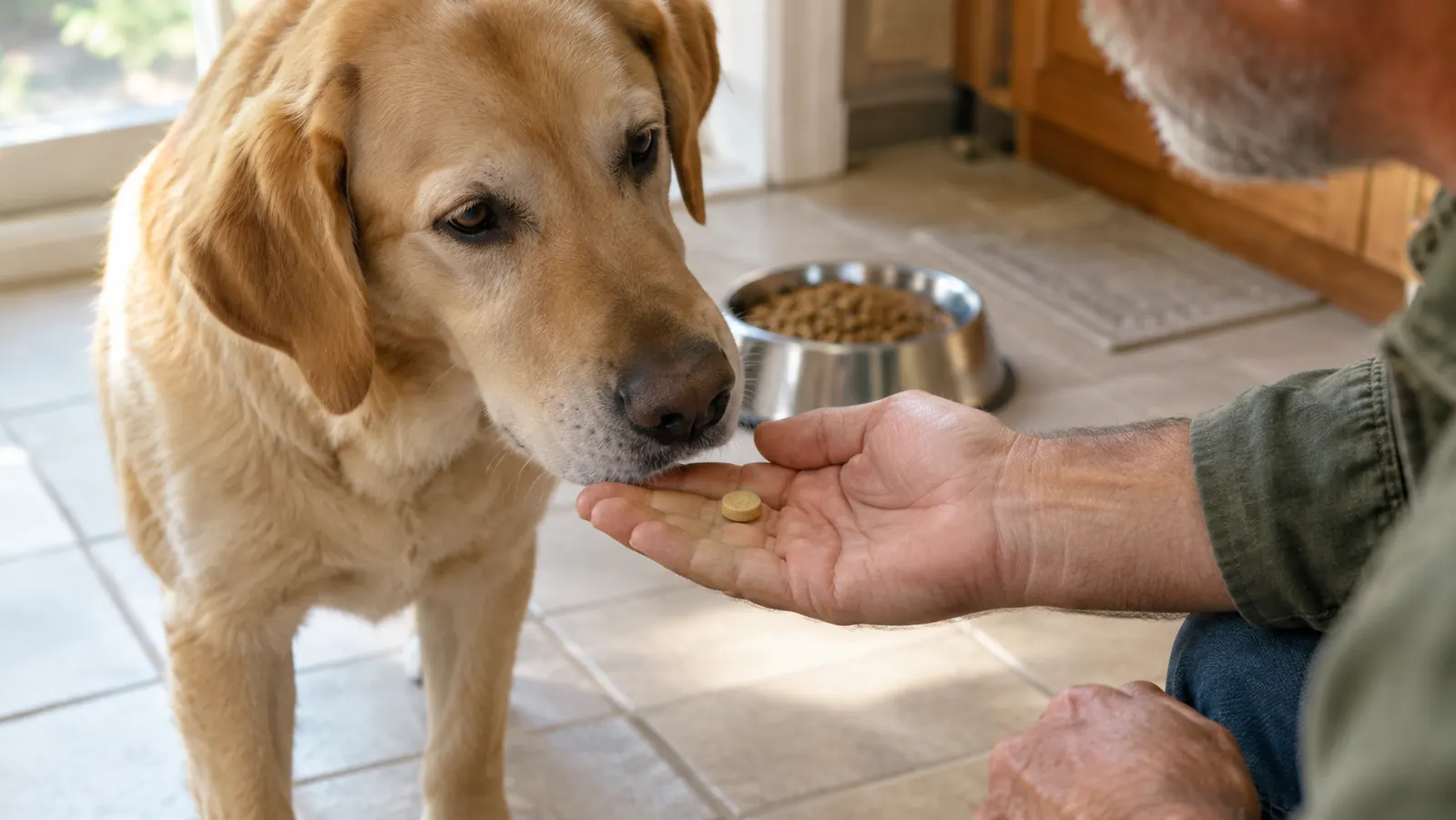
Biscuit took the tablet whole. That surprised me, because I had already built the whole routine in my head, the peanut butter, the crumbling it over kibble, the negotiations at seven in the morning. He took it as a treat, crunched it, and then looked at me for another one. If your dog is a gulper like mine, this is the easiest part of the whole thing. If your dog picks things out of his bowl and leaves them on the floor, you will be crumbling it, and that is worth knowing before you order a big tub.
He stayed on it from December into early March, so right around three months. I stopped in March because our vet wanted to step him up to a soft chew with an added ingredient, not because the Cosequin quit working. I want to be careful about that distinction. Stopping a supplement that is helping is not the same thing as a supplement failing, and I have read enough reviews that blur those two together to know how easy it is to do by accident.
What Nobody Tells You About the Timeline
Joint supplements are not pain pills. You do not give one at breakfast and see a different dog by dinner. Whatever is happening inside that joint is happening slowly, and the honest window people talk about is four to six weeks before you know anything at all. Our vet told me that in December. I still caught myself watching him on day four like an idiot, waiting for a sign that was never going to show up that fast.
Week one, nothing. Week two, nothing. Week three, I decided it was a waste of money and then felt guilty for thinking that about my own dog. Week four, maybe. Week four is the worst one, because maybe is exactly the thing a hopeful person invents when he has been staring at a dog for a month.
Then somewhere in week five there was a Tuesday afternoon where he got up off the laminate in the living room without that little rocking motion, the one where he shifts his weight forward before he commits to standing. I noticed it because I had been watching for it. That is the honest version of how this stuff shows up. Not a jolt. A detail you would have missed if you were not already paying attention.
This is also why I think a lot of people quit early and then say it did not work. If you stop at day twenty, you have not tested anything. You have spent three weeks being impatient, and I say that as a man who is impatient about nearly everything else in his life.
Somewhere in week five he got up off the laminate without that little rocking motion. That is the whole event. A detail you would have missed if you were not watching for it.
What Actually Changed
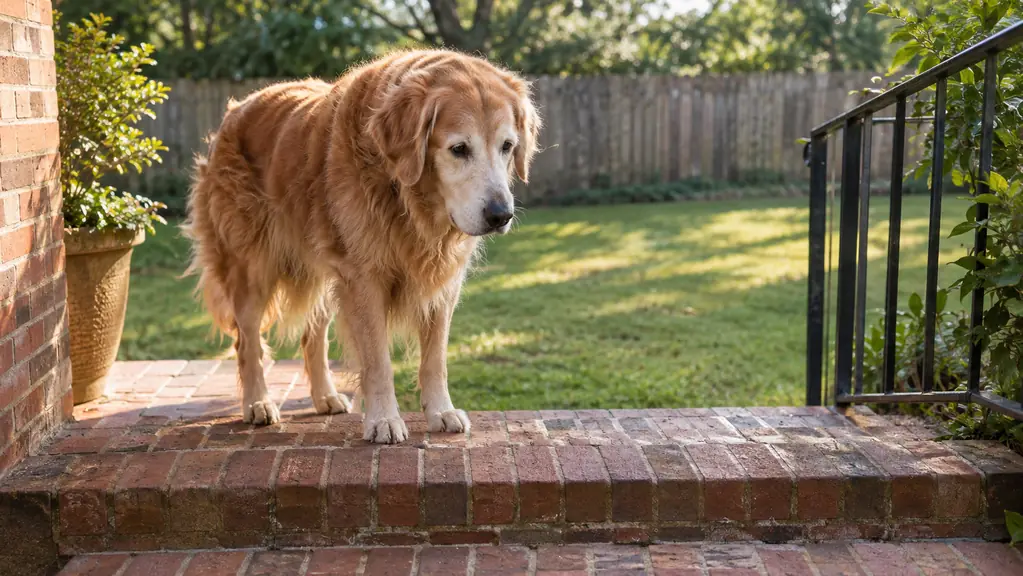
Let me separate what I would swear to from what I would only shrug at. Getting up after a nap, I would swear to. Those four brick steps down to the yard, I would swear to, with a caveat. For most of that fall he had been doing a careful shuffle on the way down, one back leg leading and the other dragging a half second behind. Sometime in February he started using all four again. Still slow. But all four.
By February he was hopping into the back seat of the truck again too. Not launching himself the way he did at six years old. He still stops, looks at the floorboard, thinks it over, and then goes. But the pause went from something he was talking himself into down to something short.
What I would only shrug at is anything to do with his attitude or his energy. He has been a happy, rotten, food-motivated dog his entire life. If he felt better, he did not announce it by acting different. He announced it by moving different, and that is a smaller signal than most people expect when they order a tub of chewables.
There was one more moment I keep coming back to. We did a short trip in the spring, one of the easier ones at a state park, and he got out of the truck at the trailhead and just stood there with his nose up instead of doing the old stiff-legged waddle to the edge of the gravel. That is not a medical outcome. It is a good afternoon. But good afternoons are the thing you are actually after here.
What I Got Wrong Along the Way
Three things. First, I expected the change to be obvious, the way it is when you switch a dog's food and his coat looks better in two weeks. This was not that. Second, I spent the first month mentally crediting every good afternoon to the tablet and ignoring the bad ones, which is not careful observation. It is hope with a calendar.
Third, and this is the one I actually regret, I treated the weight conversation as optional for about a month. Our vet asked me to get him from eighty-four pounds down to around seventy-eight, smaller portions and fewer scraps, and I dragged my feet because I like giving him things. The single biggest change in how that dog moves did not come out of a tub. It came out of a measuring cup. Any review that pretends the chew did all of it is selling you something.
The Tablet Itself, and What Is Actually in It
Cosequin chewable tablets are what the name says. The label lists glucosamine hydrochloride and sodium chondroitin sulfate, each with its own ingredient code, plus MSM. Nutramax Laboratories has been in pet health for over twenty five years, and the listing carries the number one vet recommended retail joint supplement claim, which is the kind of line I normally roll my eyes at and then quietly factor in anyway.
I gave him the label amount for his weight, which our vet checked before we started, and I did not freelance on it. I am not a vet. I coach soccer, and I have spent twenty years watching kids ice sore ankles in the back of a gym, which qualifies me to tell you what my dog did on this tablet and nothing else. What your dog should take is a question for the person who has had hands on your dog's hips.
The tub lived on the counter next to the treat jar for three months, which is a bad arrangement with a food-motivated Lab and a decent test of whether the tablets hold up. They did. Nothing crumbled to dust at the bottom, and I never had to argue with him about it once.
What It Did Not Change
The hesitation at the truck did not disappear. It got shorter. That is a real difference in my house and it is not a before and after photo. He still takes a second at the top of the steps. He still gets up slower after a long afternoon outside than he does after a nap on the rug, and he still picks the soft route across the kitchen tile when he thinks I am not looking.
It did not change the fact that he is ten, or that both hips have arthritis, or that our vet wanted to move him to a formula with an added ingredient after three months. If you are looking for the thing that ends the conversation, this is not it. It is the thing that bought me a better February.
What Happened After I Stopped
Our vet moved him to a large-breed soft chew with an added ingredient in March 2026, and that has been his daily chew since, with a pause in July and early August while his mouth healed after a tooth extraction. The change I credit to that stretch was different again. Getting up got a little smoother, and by late spring we were back to forty-minute walks instead of twenty.
I mention all of that because it is the fair question about Cosequin. Was the improvement in February the tablet, or the weight coming off, or just a good month in a Georgia winter? I cannot prove it either way, and anyone who tells you they can prove it about their own dog is guessing too. What I can tell you is that the thing our vet changed in March was the formula. The routine is what I would change first if I were starting over.
What I Would Ask Your Vet Before You Order
Three questions, and I would ask all of them before I spent anything at all. Is this arthritis, or is it something else? Is my dog at a weight where a joint supplement can even do its job? And is there anything on this label that conflicts with what he is already taking?
That last one matters more than people think once a dog is on more than one thing. Biscuit has been on a liquid fish oil since January 2026, also at our vet's suggestion, and I ran the Cosequin past her before I added it rather than after. Two products that are both good for a dog are not automatically good together, and I am not qualified to make that call. She is.
One more, and this is the unglamorous one. Ask what the plan looks like at three months. Our vet had an answer ready, and it turned out to be a step up in formula. If your vet does not have an answer, that is worth noting, because a supplement with no checkpoint is just a subscription.
What I Liked
- Biscuit took the tablet whole as a treat, so there was no hiding it in peanut butter
- Change showed up around week five and held steady through the three months
- Glucosamine hydrochloride, sodium chondroitin sulfate and MSM are all on the label, nothing to guess at
- The larger count tub covers a long stretch, so you are not reordering every few weeks
- It is the brand most vets bring up first, which made the conversation with ours simple
Where It Falls Short
- Weeks one through four look like nothing, and that is a long time to keep watching closely
- It is a tablet, so a dog who picks his food apart will need it crumbled
- Our vet moved us to a formula with more ingredients after three months, so this was not the end of the road
- It did not remove the hesitation at the truck, it only shortened it
- No supplement replaces getting the weight down and keeping the walks short and steady
Who This Is For
This is for the person who has already had the conversation. Your vet has felt the hips or the knees, has used the word arthritis or stiffness or dysplasia, and has suggested a joint supplement alongside weight and steady exercise. That was exactly the spot I was in, and Cosequin, the chewable from Nutramax Laboratories, was the name our vet gave me. If you are in that spot, it is a reasonable first chew to try.
It is also for the person who can leave a thing alone for five or six weeks before judging it. If you switch dog food every ten days because the bag looks nicer, this will make you crazy.
One thing I would not do is use it as a reason to skip the walks. Short and steady, every day, on ground he can handle. Our vet was clear about that with me and I have stayed clear about it since.
Who Should Skip It
Skip it if nobody has looked at your dog yet. Stiffness in an older dog can be arthritis and it can be several other things, and a chewable does not tell you which one you are dealing with. Our vet found Biscuit's hips at a regular checkup I nearly cancelled because I was tired that week.
Skip it if your dog will not take a tablet and you are not going to crumble one, because a supplement that ends up on the kitchen floor does nothing at all. And skip it if what you are really shopping for is a pain pill. If your dog is yelping, refusing to go outside, or guarding a leg, that is a call to your vet today, not an order to place tonight.
Three months, one stubborn dog, and a shorter pause at the truck
Cosequin chewable tablets are what our vet named first for Biscuit. Ask yours about your dog, then read the label for yourself and give it a fair six weeks.
Amazon Check Today's Price on Amazon →